

Employee commuting is one of the most significant sources of indirect greenhouse gas (GHG) emissions for many organizations. Every day, employees travel between their homes and workplaces using different transport modes, travel varying distances, and follow different work arrangements. According to GHG Protocol, these emissions are reported under Scope 3 Category 7 - Employee Commuting.
Employee commuting data is often scattered across multiple systems, organizations may rely on HR databases, attendance systems, employee surveys, or spreadsheets, each containing different levels of detail. For organisations operating across multiple offices or countries, varying transport infrastructure, commuting habits, and data availability further increase reporting complexity.
Greenetrix simplifies this process by integrating with HR systems and automating the collection, preparation, and calculation of employee commuting data. For organizations with unique data structures, Greenetrix also provides customized data integration services to transform raw datasets into reporting-ready commuting records. The result is a scalable, transparent, and audit-ready approach to Scope 3 reporting.
Building Employee Commuting Profiles
The process begins by collecting employee commuting information from HR systems, attendance records, employee surveys, or other organizational data sources. Typical information includes:
- Employee identifier
- Transport mode
- Home and workplace locations
- Commuting distance
- Attendance or working days
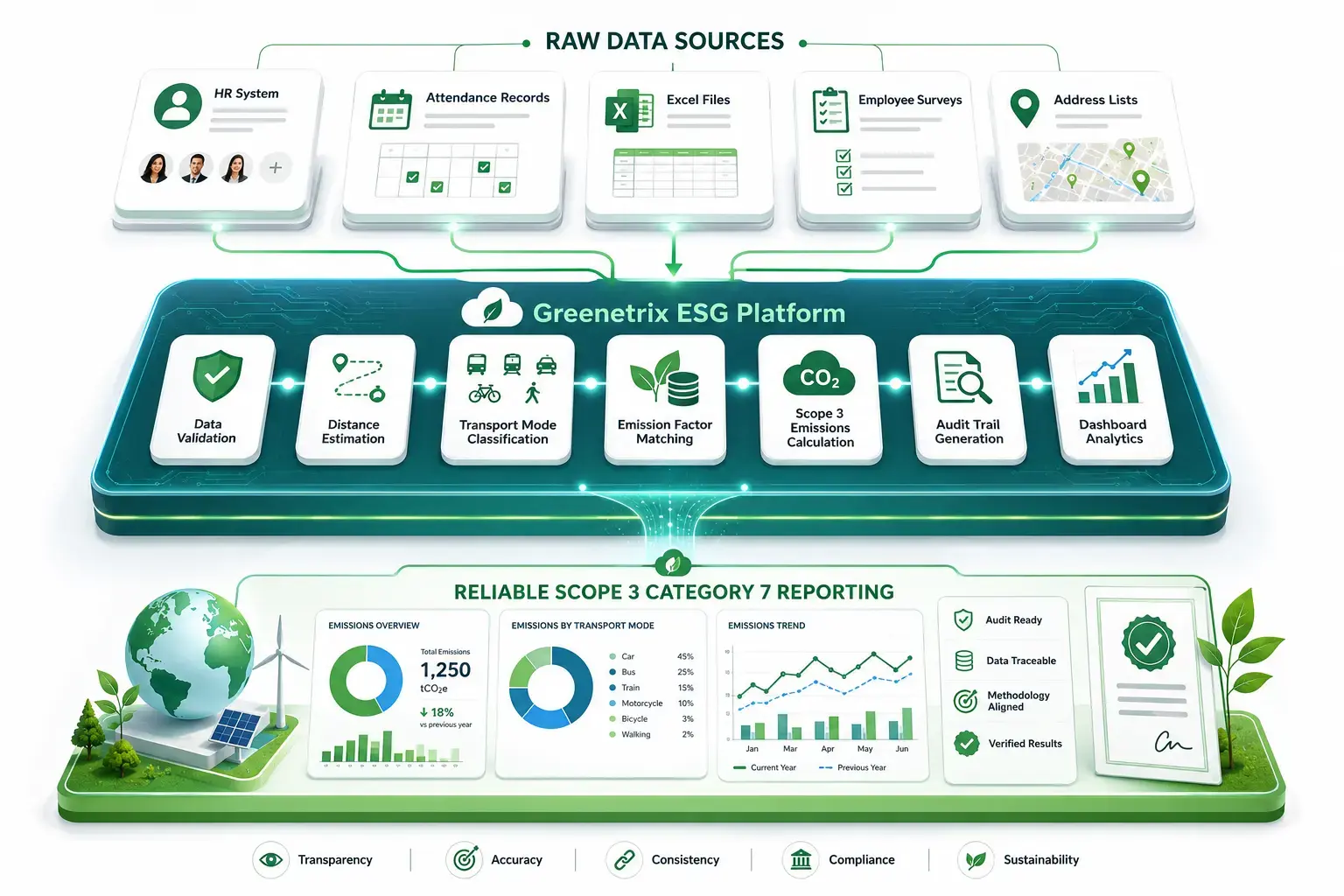
Greenetrix automatically validates and harmonizes the information into a consistent commuting dataset, regardless of its original format. Where commuting distance is unavailable, users may provide home and workplace addresses for Greenetrix to automatically calculate travel distance.
The platform supports both daily and annual commuting datasets, automatically expanding annual records into estimated daily commuting activities using transparent assumptions. Daily records are recommended for more accurate reporting and richer trend analysis. Greenetrix intelligently calculates employee commuting emissions based on the information available for each record, applying the most appropriate calculation methodology while clearly identifying any assumptions used. This enables organizations to generate reliable emissions estimates even when certain commuting information is unavailable. Additional organizational information such as department, position, gender, and operating country can also be incorporated to support deeper analysis of commuting behaviour across different employee groups.
Understanding How Employees Commute
Employees often describe the same transport mode differently. Greenetrix applies a predefined rule-based transport mapping to recognize these variations and classify them into standard transport categories aligned with recognized reporting frameworks. Where available, vehicle fuel type is incorporated to further improve calculation accuracy. If transport mode is unavailable, Greenetrix applies a predefined assumption and flags the record for user review, ensuring both automation and transparency.
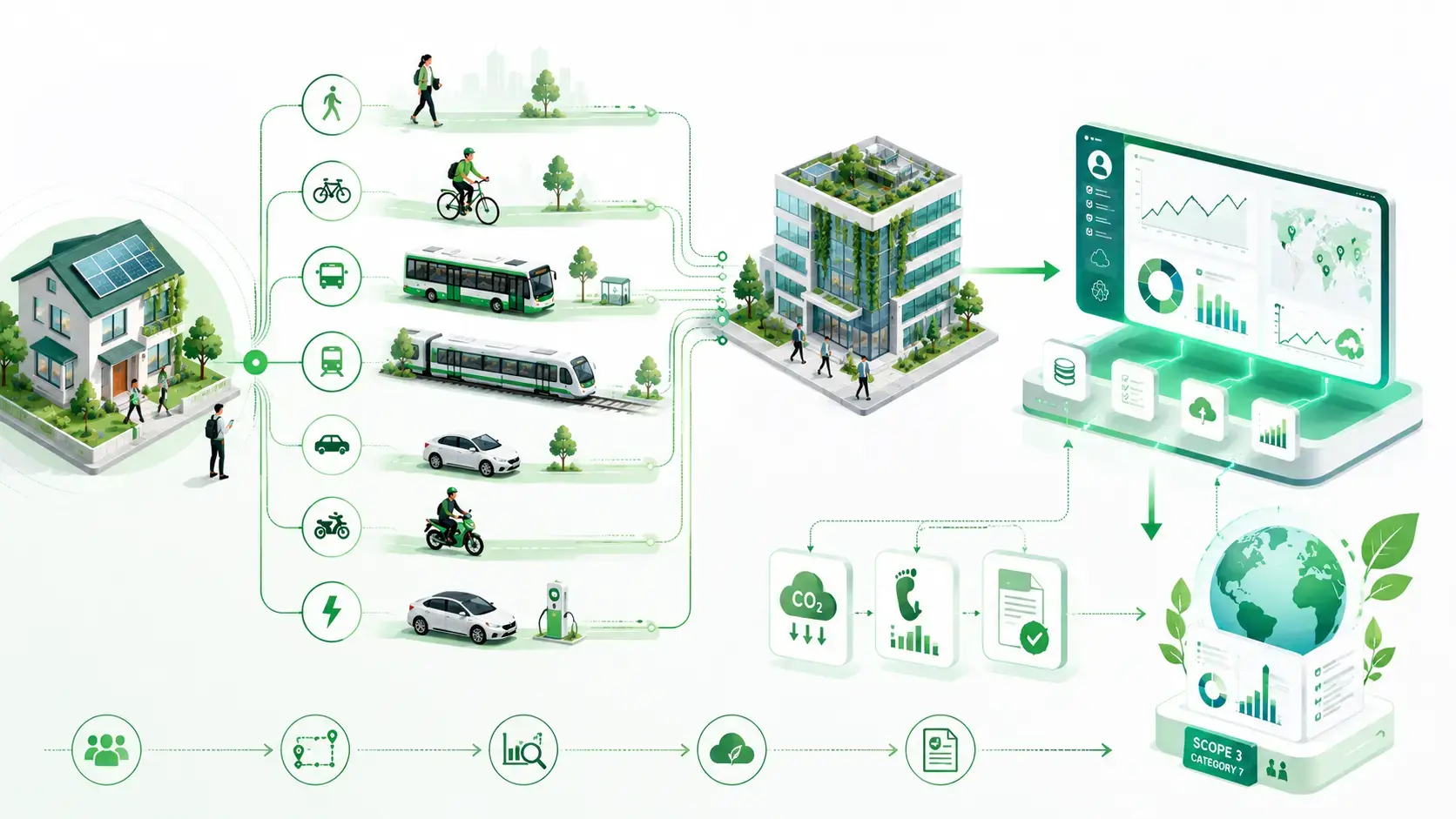
Calculating Scope 3 Category 7 Emissions
Each employee’s commuting activity is converted into GHG emissions using recognized emission factors based on:
- Organization’s financial year
- Selected reporting framework (e.g. GHG Protocol, DEFRA)
- Transport mode
- Fuel type, where applicable
- Other relevant activity attributes
However, Greenetrix is not limited to the parameters listed above. Our platform is designed to flexibly apply the most appropriate emission factors based on the user’s available data, reporting requirements, and calculation needs.
Greenetrix currently supports reporting periods from FY2024 onwards, automatically applying the appropriate emission factors for each reporting year. Once commuting activity has been determined, GHG emissions are calculated using a distance-based approach and the results are reported in tonnes of carbon dioxide equivalent (tCO₂e). Every commuting record remains fully traceable to its original employee data, providing a clear and auditable reporting trail.
Turning Commuting Data into Actionable Insights
Employee commuting data provides far more than emissions reporting. By automating data integration, validation, and emissions calculation, Greenetrix enables organizations to understand commuting behaviour across departments, operating countries and more.
Our interactive dashboards help ESG teams monitor commuting emissions over time, identify emission hotspots, evaluate sustainable commuting initiatives, and measure progress towards decarbonization targets. Greenetrix transforms employee commuting data into reliable, audit-ready Scope 3 emissions information, helping organizations simplify compliance while making better-informed decisions to reduce their commuting-related carbon footprint.